


Veteran NZ actor’s theatre of hope turns real-life pain into powerful stories of redemption (Media story about Out the Gate, Nov 2025)

Sarah Catherall
12 Nov, 2025 06:00 AM6 mins to read

Saulo Kolio stands on stage in a makeshift theatre and acts out the role of a drug dealer. It’s night three of Te Rākau theatre’s new play, Out the Gate, and Kolio, 49, is among the cast of 16. The themes feel hauntingly close for the Samoan amateur actor, who was addicted to drugs and alcohol until six years ago, and was jailed in his 30s.
Out the Gate is the latest work by veteran actor Jim Moriarty and his creative and life partner, psychologist Helen Pearse-Otene, and is based on hard truths about the impact of prisons on Māori and their whānau.
The play is being performed in marae and community settings, because Moriarty and Pearse-Otene, through their Māori theatre company, Te Rākau Hua O Te Wao Tapu, aim to use theatre to help at-risk communities transform their view of the world.
Kolio is one of eight in the cast who’ve been in prison. The stories and the fictional characters they act out are real for the Samoan father of seven, who conducted some of the research for the play.
A poignant moment comes at the end when Kolio shares his own journey away from prison life and drug and alcohol addictions, but tells the audience that demons still haunt him. Afterwards, he wells up when he tells the Listener about a moment seven years ago, when he joined a men’s behavioural change group run by Moriarty and Pearse-Otene at Kōkiri Marae, in Seaview, Lower Hutt.
At the time, Kolio was at rock bottom: violent to his partner and mother of his children, and an addict. He had suffered sexual abuse as a child and grew up in a violent home. Jailed for drugs, he mixed with the same circle after his release and thought he could continue his lifestyle.
The course was transformative. Moriarty and Pearse-Otene helped him realise his anger and resentment were destructive, and he couldn’t rewrite his past but could change how he reacted to it.
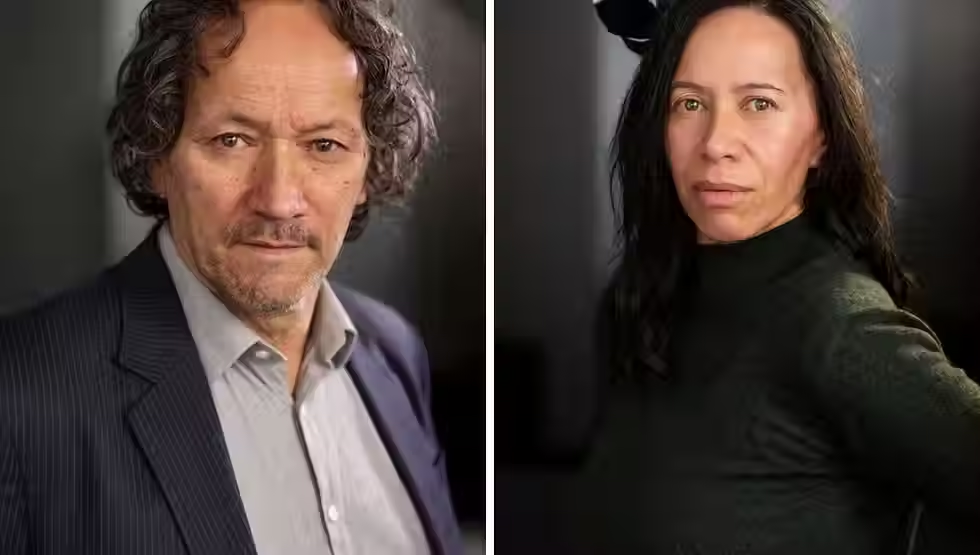
Since its formation, Te Rākau’s theatre work has been aimed at wellbeing and social justice. Moriarty, who is kaitohu (director) for Out the Gate, rose to prominence playing school teacher Riki Winiata in 1970s soap Close to Home, and went on to an impressive acting career on stage and screen. Also a registered psychiatric nurse, he says Māori are over-represented in prisons. Ministry of Justice figures show they make up 53% of the prison population but only 16% of the general population. “Those are drivers for me to say, ‘What can I do about that?’”
In the play, powerful transformation stories like Kolio’s sit alongside others shared through a three-year Health Research Council-funded project, Tiaki – community wellbeing for whānau with lived experience of incarceration. Tiaki researcher Associate Professor Paula King of the University of Otago, says the play is a powerful way to share research that might otherwise mainly be read by only academics and policymakers.
“The play encourages audiences to be accountable for creating the world that we actually want to live in, and that we want our mokopuna to live in; that all of us have a role to play,” she says.
Most of Out the Gate’s 16 adult actors have performed in Te Rākau plays before. As the kaituhi (playwright), Pearse-Otene took the Tiaki research and real-life stories into what is known as process theatre, where the actors help form the dialogue and narrative. Moriarty and Pearse-Otene’s two young adult children, Hariata Moriarty and Tamati Moriarty, also feature.
Starting with a blank sheet, the actors with experience of prison shared those experiences and other traumas such as sexual abuse, crime, violence and drug addiction, which formed part of the script, and validates the work, says Pearse-Otene.
Kolio had no acting experience but since stepping into Kōkiri Marae has performed in two Te Rākau theatre works: Unreel (2024), about gambling harm, and The Swing, on intergenerational sexual abuse. He has a sense of purpose and has also done a social work diploma and a painting apprenticeship under Moriarty’s wing.
Kolio tells the Listener acting in Out the Gate reminds him he spent a lot of his adult life acting. “I use my real name now. Before I went on that programme, I was so many different characters in real life and I was so tired. That’s what happens when you don’t want to be yourself.”
Six years sober, his partner and children get to see the real him. “Without this change, I would either be dead or in jail now.”

The play’s poignant content is balanced by waiata sung by the cast, classical guitar played live by Rameka Tamaki, and movement choreographed by Tanemahuta Gray.
Moriarty and Pearse-Otene did not want Out the Gate to be didactic or preachy’. “This play is about accountability,” says Moriarty. “What are you going to do about that wounded child inside of you as a result of all those traumatic experiences? Somewhere along the journey you’ve got to try to have a different relationship with those things. The past is what it is. As you unravel it in a safe way, you can have some autonomy and agency over it. That sits under all our work.”
He was determined the latest project should be shown in marae and community spaces like Māoriland in Ōtaki, where the Listener watched it. “Accessibility is important,” he says afterwards. “The mountain doesn’t come to Mohammad so you’ve got to get smart about it. I grew up on a marae in Porirua and the most dramatic place in my life is the marae so we try to replicate that in this piece of theatre.”
Out the Gate is performed in a stripped-back space. The audience meet the “tamariki” – the 16 actors singing Takiri Mai Te Haeata, a song to the dawn. The structure starts with the promise of hope, that all tamariki begin with the same dreams. What follow are scenarios of sexual abuse, shoplifting, drug dealing, ram raids and prison, followed by scenes of hope and reconciliation.
The play ends with real and moving stories of the actors who break the cycle of recidivism. In New Zealand, 37% of inmates will return to jail within two years of release.
At the end of each performance, the audience can join in a kōrero. Judges and teachers have seen it, says Moriarty, along with a man who apologised for his violence towards women in the public forum. Moriarty hopes Out the Gate will not end on the final night, and social change may come from it.
“It’s a metaphor that the child is brought up in a place of nurturing and promise,” he says. “The play shows you what happens and we postulate a pathway out of there. It’s as honest as we can make it.”
Out The Gate by Te Rākau theatre is touring marae and venues in the lower North Island until November 16. For details see terakau.org/out-the-gate.


Comments